

What is the self - inductance of a 12 Volt Solenoid Coil?
Hey there! As a supplier of 12 Volt Solenoid Coils, I often get asked about the self - inductance of these coils. So, let's dig into it and figure out what self - inductance means for a 12 Volt Solenoid Coil.
First off, what's self - inductance? Well, it's a property of an electrical conductor, like a solenoid coil. When the current flowing through a conductor changes, it creates a changing magnetic field around it. This changing magnetic field, in turn, induces an electromotive force (EMF) in the same conductor. That's self - inductance in a nutshell. It's like the coil is having a bit of a tug - of - war with itself when the current changes.
Now, for a 12 Volt Solenoid Coil, self - inductance plays a crucial role. The coil is designed to operate at 12 volts, and the self - inductance affects how it responds to changes in the electrical current. A higher self - inductance means that the coil will resist changes in current more strongly. When you first apply the 12 volts, it takes a bit more time for the current to reach its steady - state value because the self - induced EMF is opposing the change in current.
Let's talk about the factors that influence the self - inductance of a 12 Volt Solenoid Coil. One of the main factors is the number of turns in the coil. The more turns there are, the higher the self - inductance. This is because each turn adds to the magnetic field created by the coil. When you have more turns, the magnetic field is stronger, and the induced EMF is greater when the current changes.
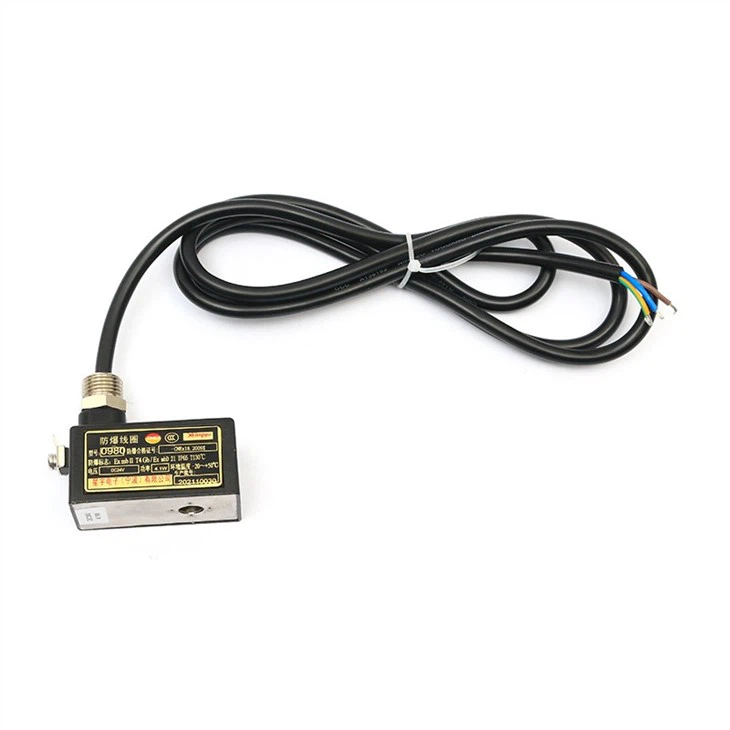

Another factor is the cross - sectional area of the coil. A larger cross - sectional area generally leads to a higher self - inductance. This is because a larger area allows for a greater magnetic flux to pass through the coil. Think of it like a bigger pipe allows more water to flow through. In the case of a solenoid coil, a larger cross - sectional area allows more magnetic field lines to pass through, increasing the self - inductance.
The length of the coil also matters. A shorter coil typically has a higher self - inductance compared to a longer one. When the coil is shorter, the magnetic field lines are more concentrated, and the interaction between the turns is stronger. This results in a greater induced EMF when the current changes.
The core material inside the coil can have a huge impact on self - inductance too. If the coil has a ferromagnetic core, like iron, the self - inductance can be significantly higher. Ferromagnetic materials have high magnetic permeability, which means they can enhance the magnetic field created by the coil. This leads to a stronger induced EMF and thus a higher self - inductance.
Now, why does all this matter for a 12 Volt Solenoid Coil? Well, in practical applications, the self - inductance affects the coil's performance. For example, if you're using the solenoid coil in a circuit where rapid switching is required, a high self - inductance can cause problems. When you try to turn the coil on or off quickly, the self - induced EMF can create voltage spikes. These spikes can damage other components in the circuit.
On the other hand, in some applications, a high self - inductance can be an advantage. For instance, in power supply filtering circuits, a solenoid coil with high self - inductance can help smooth out fluctuations in the current. It acts like a buffer, resisting sudden changes in current and providing a more stable output.
As a supplier of 12 Volt Solenoid Coils, we understand the importance of getting the self - inductance right. We carefully design our coils to meet the specific requirements of different applications. Whether you need a coil with low self - inductance for fast - switching applications or high self - inductance for power filtering, we've got you covered.
If you're in the market for solenoid coils, you might also be interested in other types of coils like the ex proof 220vac solenoid coil or the pneumatic solenoid valve coil 220vac. These coils are designed for different voltage requirements and applications. And if you specifically need a 220V AC Solenoid Valve Coil, we can offer some insights on those too.
We're here to help you find the perfect solenoid coil for your needs. Whether it's understanding the self - inductance of a 12 Volt Solenoid Coil or choosing the right coil for your project, our team of experts is ready to assist. If you have any questions or want to start a procurement discussion, don't hesitate to reach out. We're committed to providing high - quality solenoid coils and excellent customer service.
References:
- "Electromagnetism: Principles and Applications" by Paul M. Nahin
- "Introduction to Electric Circuits" by Richard C. Dorf and James A. Svoboda