

What is the thermal resistance of a 24 Volt Solenoid Coil?
What is the thermal resistance of a 24 Volt Solenoid Coil?
Hey there! I'm a supplier of 24 Volt Solenoid Coils, and today we're going to dig into the nitty - gritty of thermal resistance in these coils.
First off, let's understand what thermal resistance actually is. In simple terms, thermal resistance is like a "roadblock" for heat flow. It measures how difficult it is for heat to pass through a material. For a 24 Volt Solenoid Coil, thermal resistance plays a super important role.
When a current flows through the 24 Volt Solenoid Coil, the electrical energy gets converted into heat energy due to the resistance of the wire in the coil. This is just like what happens in any electrical device. The more current, the more heat is generated. But if the heat can't escape effectively, it can build up inside the coil.
Now, why is it such a big deal? Well, excessive heat can damage the insulation around the coil wire. Once the insulation is damaged, it can lead to short - circuits, and you definitely don't want that. A short - circuit can cause the solenoid to stop working properly or, even worse, lead to a safety hazard.
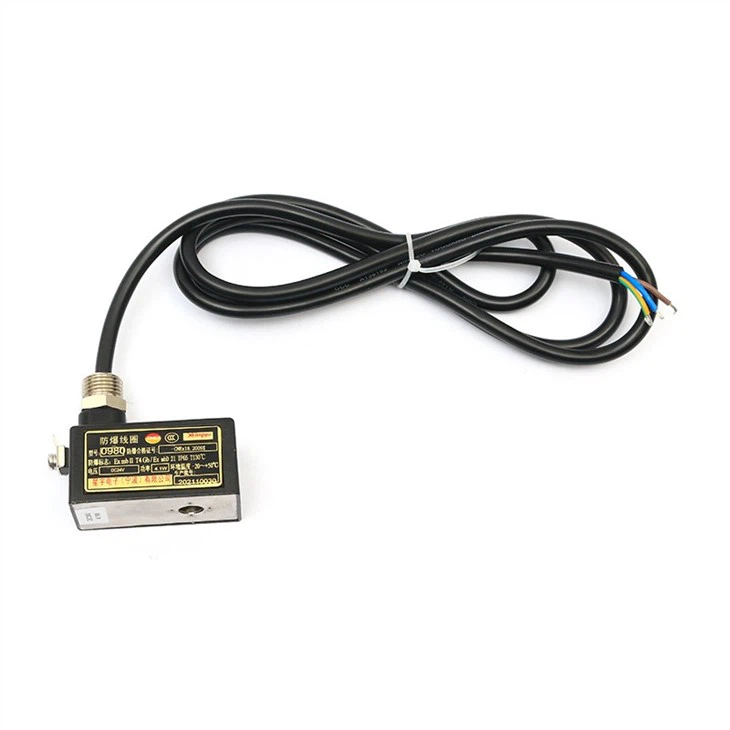

Let's talk about the factors that affect the thermal resistance of a 24 Volt Solenoid Coil. The first factor is the type of material used in the coil. Different materials have different abilities to conduct heat. For example, copper is a great conductor of both electricity and heat. So, if a 24 Volt Solenoid Coil is made of high - quality copper wire, it will have a relatively lower internal resistance, which means less heat is generated in the first place. And because copper is a good heat conductor, the heat that is generated can spread out more easily.
The design of the coil also matters a lot. The number of turns in the coil affects the resistance and thus the heat generation. A coil with more turns will generally have a higher resistance. If the coil is tightly wound, heat might get trapped more easily, increasing the thermal resistance. On the other hand, if the coil has proper spacing between the turns, it allows for better air circulation, which helps in dissipating heat, reducing the overall thermal resistance.
The environment where the 24 Volt Solenoid Coil is used is another crucial factor. If it's in a hot and poorly - ventilated area, the heat won't be able to escape as effectively. For example, if the solenoid is placed inside a closed cabinet with other heat - generating devices, the temperature around the coil will be high, and the thermal resistance will seem like it's working against you.
Now, how do we measure the thermal resistance of a 24 Volt Solenoid Coil? There are some standard methods out there. One common way is to measure the temperature difference between two points on the coil when a known amount of heat is being generated. The thermal resistance (Rθ) is then calculated using the formula Rθ = ΔT / P, where ΔT is the temperature difference and P is the power dissipated in the coil.
We, as a 24 Volt Solenoid Coil supplier, take all these factors into consideration when manufacturing our coils. We use high - quality materials to ensure low heat generation and good heat conduction. Our design team focuses on creating coils with optimal turn - spacing to improve air circulation.
If you're in the market for a reliable 24 Volt Solenoid Coil, look no further. We've got a range of products that are designed to have low thermal resistance, ensuring long - term and stable performance.
And speaking of our product range, we also offer a 24vdc Explosion Proof Solenoid Coil. This coil is specially designed for use in explosive environments, where safety is of the utmost importance.
Another great product in our lineup is the Solenoid Valve Spool Core. This core is an essential part of many solenoid valves, and it works hand - in - hand with our 24 Volt Solenoid Coils.
We also have the 220v Ac Solenoid Valve Coil for those who need a coil operating at a different voltage.
So, whether you're working on a small - scale project or a large - scale industrial application, we've got the right 24 Volt Solenoid Coil and related products for you. If you have any questions about thermal resistance, our product range, or you're just interested in getting a quote, don't hesitate to reach out. We're here to have a friendly chat and help you find the best solution for your needs.
Let's work together to make your projects a success! Whether it's for an automation system, a fluid control application, or anything in between, our 24 Volt Solenoid Coils are up to the task.
References:
- Electrical Engineering Handbook on Solenoid Technology
- Textbooks on Basic Electronics and Heat Transfer Principles