

What is the demagnetization factor of a 24 Volt Solenoid Coil?
In the realm of electromagnetism, solenoid coils play a pivotal role, with 24 Volt Solenoid Coils being a popular choice across various industries. As a trusted supplier of 24 Volt Solenoid Coils, I often encounter questions regarding the demagnetization factor of these coils. Understanding this concept is crucial for optimizing the performance and longevity of solenoid - based systems.
Understanding the Basics of a 24 Volt Solenoid Coil
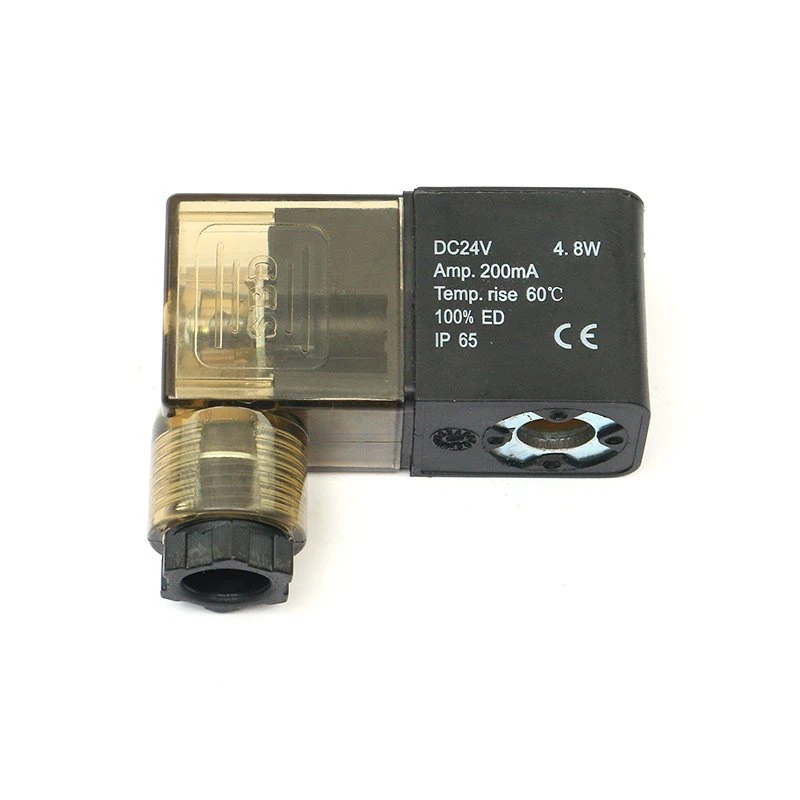
A 24 Volt Solenoid Coil is an electromagnetic device that converts electrical energy into mechanical energy. When an electric current is passed through the coil, it generates a magnetic field. This magnetic field can then be used to move a plunger or other mechanical components, making solenoid coils essential in applications such as solenoid valves, actuators, and relays.
The 24 - volt rating indicates the voltage at which the coil is designed to operate most efficiently. Using the correct voltage is vital, as operating the coil at a different voltage can lead to issues such as overheating, reduced magnetic strength, or even damage to the coil.
What is the Demagnetization Factor?
The demagnetization factor, denoted as (N), is a dimensionless quantity that describes how the magnetic field inside a magnetized object (in this case, a solenoid coil) is reduced due to its own magnetic field. When a solenoid coil is magnetized, the magnetic field it generates has two components: the applied magnetic field ((H_{app})) and the demagnetizing field ((H_{d})).
The demagnetizing field acts in the opposite direction to the applied magnetic field, effectively reducing the net magnetic field inside the coil. Mathematically, the relationship between the applied magnetic field, the demagnetizing field, and the magnetization ((M)) of the coil is given by (H_{d}=-N M).
The demagnetization factor depends on the shape, size, and orientation of the solenoid coil. For a solenoid, the demagnetization factor is influenced by its length - to - diameter ratio ((l/d)). In general, a solenoid with a large length - to - diameter ratio has a smaller demagnetization factor, while a solenoid with a small length - to - diameter ratio has a larger demagnetization factor.
Factors Affecting the Demagnetization Factor of a 24 Volt Solenoid Coil
Shape and Dimensions
As mentioned earlier, the shape of the solenoid coil has a significant impact on its demagnetization factor. A long and thin solenoid has a lower demagnetization factor because the magnetic field lines are more concentrated along the axis of the coil, and there is less self - cancellation of the magnetic field. On the other hand, a short and fat solenoid has a higher demagnetization factor as the magnetic field lines are more spread out, leading to more self - cancellation.
Core Material
The core material of the solenoid coil also affects the demagnetization factor. If the solenoid has a ferromagnetic core, such as iron or steel, the magnetization of the core can contribute to the demagnetizing field. Ferromagnetic materials have high magnetic permeability, which means they can be easily magnetized. However, this also means that the self - demagnetizing effect can be more pronounced.
Number of Turns
The number of turns in the solenoid coil can influence the demagnetization factor. A solenoid with a larger number of turns will have a stronger magnetic field for a given current. However, this also means that the self - demagnetizing effect can be more significant, as the magnetic field generated by each turn interacts with the fields of the other turns.

Importance of the Demagnetization Factor in 24 Volt Solenoid Coils
Understanding the demagnetization factor is crucial for several reasons when dealing with 24 Volt Solenoid Coils.
Performance Optimization
By minimizing the demagnetization factor, we can maximize the magnetic field strength inside the solenoid coil. This leads to more efficient operation, as the coil can generate a stronger magnetic force with the same amount of electrical energy. For applications such as solenoid valves, a stronger magnetic force means faster and more reliable operation of the valve.
Energy Efficiency
A lower demagnetization factor also contributes to energy efficiency. When the demagnetizing field is reduced, less energy is wasted in overcoming the self - cancellation of the magnetic field. This means that the solenoid coil can operate at a lower power consumption, reducing operating costs and environmental impact.
Longevity of the Coil
Excessive demagnetization can lead to increased heat generation in the solenoid coil. Heat is one of the main factors that can cause damage to the coil over time, such as melting the insulation or causing the wire to break. By controlling the demagnetization factor, we can reduce heat generation and extend the lifespan of the coil.
How to Calculate the Demagnetization Factor of a 24 Volt Solenoid Coil
Calculating the demagnetization factor of a solenoid coil is a complex task that typically requires advanced mathematical models and numerical methods. However, for a simple solenoid with a uniform cross - section and a long length - to - diameter ratio, an approximate formula can be used.
For a solenoid with a length (l) and a diameter (d), the demagnetization factor (N) can be estimated using the following empirical formula:
[N\approx\frac{1}{1 + (l/d)^2}]
This formula provides a rough estimate of the demagnetization factor and is valid for solenoids with (l/d>1). For more accurate calculations, especially for solenoids with complex shapes or non - uniform magnetization, finite element analysis (FEA) software can be used. FEA software can simulate the magnetic field distribution inside the solenoid coil and calculate the demagnetization factor based on the actual geometry and material properties of the coil.
Our Offerings as a 24 Volt Solenoid Coil Supplier
As a supplier of 24 Volt Solenoid Coils, we understand the importance of the demagnetization factor and its impact on the performance of the coils. We offer a wide range of solenoid coils with carefully designed shapes and dimensions to minimize the demagnetization factor.
Our coils are made from high - quality materials, including high - grade copper wire and ferromagnetic cores with optimized magnetic properties. We also use advanced manufacturing techniques to ensure uniform winding of the coil, which helps to reduce the self - demagnetizing effect.
In addition to our standard 24 Volt Solenoid Coils, we also offer customization services. If you have specific requirements for the shape, size, or performance of the solenoid coil, our team of experts can work with you to design and manufacture a coil that meets your exact needs.
Related Products
We also supply other related products, such as the Solenoid Valve Spool Core, which is an essential component in solenoid valves. Our 110v Ac Solenoid Coil is suitable for applications that require a different voltage. And for those in need of a higher - voltage option, our Pneumatic Solenoid Valve Coil 220vac provides reliable performance.
Contact Us for Procurement
If you are interested in our 24 Volt Solenoid Coils or any of our other products, we invite you to contact us for procurement. Our team of sales representatives is ready to assist you with your inquiries, provide detailed product information, and discuss your specific requirements. Whether you are looking for a standard coil or a customized solution, we are committed to providing you with high - quality products and excellent customer service.
References
- Purcell, E. M., & Morin, D. J. (2013). Electricity and Magnetism. Cambridge University Press.
- Griffiths, D. J. (2017). Introduction to Electrodynamics. Cambridge University Press.
- Bozorth, R. M. (1993). Ferromagnetism. IEEE Press.